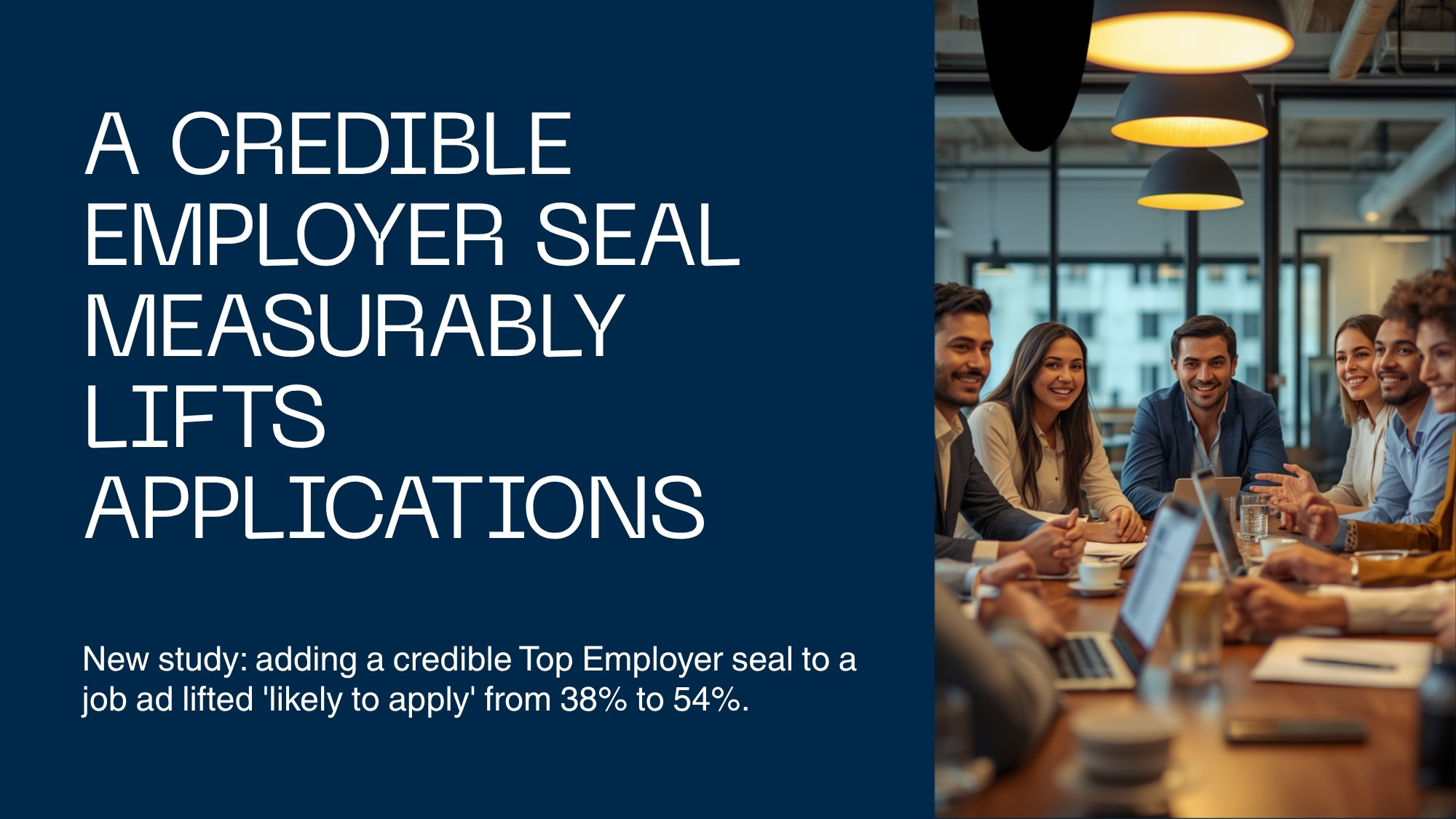
A randomised study by PhDr. Oliver Scharfenberg shows a credible Top Employer seal raises willingness to apply – but only when the method holds up.
SHERIDAN, WY, UNITED STATES, June 16, 2026 /EINPresswire.com/ — When a job advertisement carries a credible employer seal, more people say they would apply for it. That is the central finding of a randomised experiment that now sits behind the Top Employer certificate, the employer certification issued through the International Network for Standardization and Certification. It gives recruiters something employer branding almost never offers — not a glowing testimonial, but a controlled, before-and-after measurement of how a Top Employer seal actually changes the way candidates behave.
In the study by PhDr. Oliver Scharfenberg, 1,093 participants with a representative age distribution were each shown the same job advertisement. One detail changed from one version to the next: whether the ad displayed a “Top Arbeitgeber” (Top Employer) quality seal. Without it, 37.96 percent of respondents rated an application as likely or very likely. With the seal in place, that share climbed to 53.95 percent, while the proportion who called an application unlikely or very unlikely dropped from 17.88 percent to 6.04 percent. Same role, same pay, same company description — the seal was the only thing that moved, so the shift can be put down to the signal itself.
Why should a small graphic change anything? The answer comes from information economics, and it is older than any employer ranking. A candidate cannot see what matters most about a workplace before signing a contract: the real culture, the quality of management, whether people are treated well day to day. Economists call this a credence good (Darby and Karni, 1973). And as George Akerlof showed in his work on the “market for lemons” (1970), when buyers cannot tell good from bad, they discount everyone, and genuinely strong providers get dragged down with the weak. Good employers live with exactly this problem. Their quality is largely invisible at the very moment a candidate decides.
Signalling theory (Spence, 1973) describes the way out: a party holding hidden quality can prove it by sending a signal that is costly and hard to fake. An independent, third-party certification is precisely that kind of signal, because the judgement moves to an outside body and can be checked rather than simply claimed. “A seal doesn’t talk anyone into ignoring a bad employer,” Scharfenberg said. “What it does is take away uncertainty. A candidate can’t see your culture from the outside. A credible Top Employer certificate gives them a reason to trust what they can’t directly observe — and that reason has to be earned, not bought.”
The same body of research carries a warning that is easy to skip past. Examining more than sixty employer seals on the market, Scharfenberg documented that a large share of them show real methodological weaknesses — in some cases manufacturing the impression of an independent, neutral assessment when no such thing has taken place. His conclusion is uncomfortable but hard to argue with: a weak seal dressed up as a strong one is arguably worse than no seal at all, because it adds noise to the market in the same way Akerlof’s lemons do. A signal everyone can buy stops being a signal.
This is the logic the Top Employer certification is built to respect. The award criteria are published openly rather than kept behind a curtain. Every employee is invited into an anonymous, representative survey, not a hand-picked or self-selecting few. The evaluation is carried out independently of the company being assessed. And the certificate is issued only when a company actually reaches a strong enough result — it then stays valid for 24 months before a fresh survey is required. For the German market, the same standard is offered through DIQP, with national partners covering other countries.
For an HR team, the practical takeaway is simple enough. A Top Employer seal is worth displaying in exact proportion to how hard it was to earn. Keep the bar real — a genuine survey, a genuine threshold — and the recognition means something to the next candidate who sees it. Drop the bar, and you are back to a sticker. The methodology and the full criteria can be read at https://www.top-employer-certificate.com, and the wider network at https://www.quality-standard.com.
Gedrianne Abadies
Quality Standardization and Certification LLC
email us here
Top employer
Legal Disclaimer:
EIN Presswire provides this news content “as is” without warranty of any kind. We do not accept any responsibility or liability
for the accuracy, content, images, videos, licenses, completeness, legality, or reliability of the information contained in this
article. If you have any complaints or copyright issues related to this article, kindly contact the author above.

Media gallery