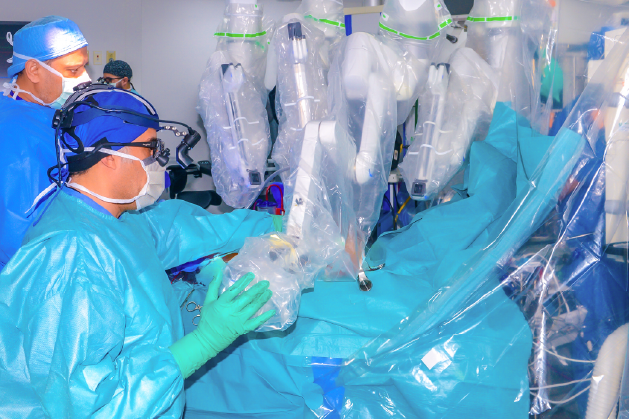
NY, UNITED STATES, September 14, 2026 /EINPresswire.com/ — King Faisal Specialist Hospital and Research Centre (KFSH) is building the local clinical workforce required to turn robotic platforms into repeatable patient care. Its model combines da Vinci systems with simulation, supervised console training and phased clinical implementation, enabling Saudi surgical teams to progress from foundational skills to increasingly complex procedures.
KFSH has progressed from adopting robotic platforms to developing applications in organ transplantation, cardiac surgery, oncology, neurosurgery and complex abdominal procedures. Its achievements include the world’s first fully robotic heart transplant and the world’s first fully robotic liver transplant, milestones that expanded the possibilities of minimally invasive surgery in procedures traditionally associated with major open intervention.
The hospital has also performed the world’s first series of single-port robotic liver resections from living donors. Conducted through one incision not exceeding 3.5 centimeters, the approach replaced the multiple incisions used in conventional robotic surgery while maintaining rigorous donor-safety standards.
Living donors are healthy individuals undergoing surgery for the benefit of another person, making the reduction of surgical burden particularly important. In the first reported series of six donors, the procedures resulted in minimal blood loss, no reported complications and discharge within two to three days.
The development builds on extensive institutional experience. KFSH has performed more than 1,700 robotic living-donor liver resections, described by the hospital as the highest volume globally, supported by a structured model combining simulation, training and phased clinical implementation.
Robotic systems provide surgeons with magnified three-dimensional visualization, stable instrument control and a range of motion suited to confined anatomical spaces. These capabilities can support precise dissection, preservation of surrounding structures and complex reconstruction while minimizing incision size and tissue disruption.
The value of robotic surgery extends beyond the platform itself. KFSH’s training pathway includes simulation and supervised practical experience on da Vinci systems, alongside careful patient selection, multidisciplinary planning and data-informed evaluation. This investment in local surgeons and clinical teams allows increasingly complex procedures to be introduced gradually as experience and institutional capability grow.
KFSH presents robotic surgery as an example of how healthcare institutions can translate advanced technology into repeatable clinical capability, measurable patient benefit and new global standards of specialized care. The program features in the hospital’s contribution to the C3 US NYC Davos of Healthcare™ Summit 2026, taking place today, September 14, in New York City.
King Faisal Specialist Hospital and Research Centre has been ranked first in the Middle East and Africa and 12th globally among the world’s top 250 academic medical centers for 2026. It was also recognized as the most valuable healthcare brand in the Kingdom and the Middle East for 2026, according to Brand Finance, and listed by Newsweek among the World’s Best Hospitals, World’s Best Smart Hospitals, and World’s Best Specialized Hospitals for 2026.
KFSH
Riyadh
email us here
Legal Disclaimer:
EIN Presswire provides this news content “as is” without warranty of any kind. We do not accept any responsibility or liability
for the accuracy, content, images, videos, licenses, completeness, legality, or reliability of the information contained in this
article. If you have any complaints or copyright issues related to this article, kindly contact the author above.

Media gallery