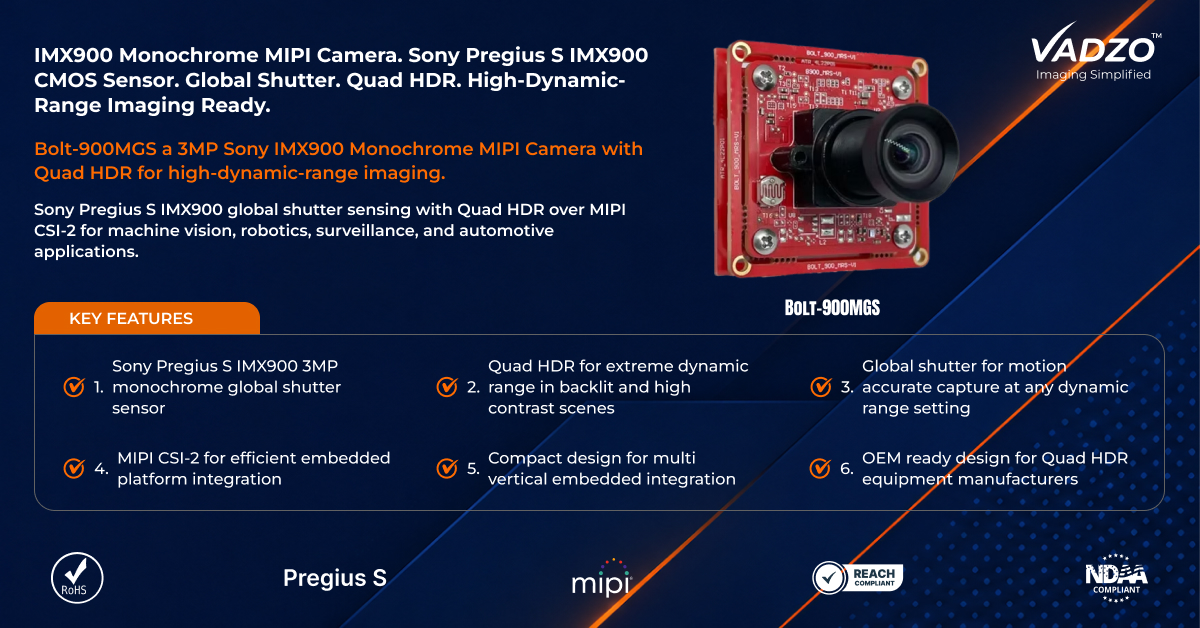
The Bolt-900MGS is a 3MP Sony IMX900 Monochrome MIPI Camera featuring Quad HDR for high-dynamic-range imaging in demanding machine vision and embedded vision applications. The Sony Pregius S IMX900 sensor combines high-resolution monochrome imaging with global shutter performance, while Quad HDR enables reliable capture of detail across scenes with significant variations in brightness. With a MIPI CSI-2 interface, the camera is designed for integration with embedded platforms used in machine vision, robotics, intelligent surveillance, and automotive vision systems.
BOSTON, MA / ACCESS Newswire / October 2, 2026 / Vadzo Imaging, a provider of embedded vision solutions, today announced the validation of Quad HDR on the Bolt-900MGS, an IMX900 Quad HDR MIPI Camera built around the Sony Pregius S IMX900 sensor for machine vision, robotics, surveillance, and automotive applications that need genuine extreme dynamic range across a compact, embedded platform.
Why Extreme Dynamic Range Applications Need an IMX900 Monochrome MIPI Camera Built for Quad HDR
Machine vision, robotics, surveillance, and automotive applications routinely encounter genuinely difficult scenes that combine an extremely bright light source with a deeply shadowed area within the same single frame, whether that is a backlit inspection target, a robot working near a bright window, a surveillance position facing direct sun, or an in-cabin scene combining a bright windshield with a dim interior. A Quad HDR MIPI Sensor needs to resolve detail across that full extreme range within a single exposure cycle, not just a moderately varied scene a standard HDR approach can already handle adequately.
An IMX900 3MP Quad HDR MIPI Camera approaches that challenge by capturing and combining four separate exposure settings within a single frame cycle, extending dynamic range well past what a standard two-exposure HDR technique can achieve. A four-frame HDR Camera configuration like this one gives embedded platform integrators genuine detail even when a scene combines a blinding highlight with a nearly black shadow in the same frame.
A second, related consideration is maintaining that extreme dynamic range without introducing motion distortion, since many of these applications, particularly robotics and automotive, involve genuine motion during capture. As a 3MP MIPI CSI-2 Camera, the Bolt-900MGS addresses that consideration directly with global shutter capture, exposing the entire frame at the same instant regardless of which of the four Quad HDR exposure settings is being combined at that moment.
Neither extreme dynamic range nor motion accuracy alone solves the underlying problem these applications present. A sensor with excellent Quad HDR handling but a rolling shutter architecture would still distort a moving subject regardless of how well exposed that frame otherwise turned out, and a sensor with excellent motion accuracy but only standard dynamic range would still lose detail in a genuinely extreme highlight or shadow. Combining both is what makes a sensor genuinely suited to machine vision, robotics, surveillance, and automotive work rather than adequate on only one specification.
Engineering Explanation: Four Exposures and Global Shutter Working Together
Sony designed the Pregius S IMX900 with genuine Quad HDR capability built directly into the sensor architecture itself from the ground up, and Vadzo Imaging validates that capability specifically for machine vision, robotics, surveillance, and automotive applications where standard HDR handling is not sufficient. As an IMX900 Mono MIPI Sensor, the module resolves detail across a dynamic range extreme enough to handle direct backlighting and high-contrast scenes within the same captured frame. As a Quad HDR Camera, it delivers that combination specifically for MIPI-connected embedded platforms.
That extreme range matters specifically for the lighting conditions a real embedded deployment presents rather than a controlled test scene. As a Quad HDR Sensor Module, the Bolt-900MGS holds detail in both a blown-out highlight and a deep shadow simultaneously, and a 3MP HDR MIPI Sensor configuration like this one gives integrators confidence that a subject remains identifiable regardless of where in the frame extreme brightness or darkness happens to occur. As a High DR MIPI Vision Camera, it gives integrators a genuine reference point for extreme dynamic range performance.
MIPI CSI-2 connectivity is what makes this extreme dynamic range sensor genuinely practical for embedded platform integration rather than requiring additional interface hardware. As a 3MP Quad HDR Sensor, the Bolt-900MGS connects directly to the native camera interface most embedded compute platforms already provide, avoiding the additional power draw and complexity a USB or networked interface would introduce into an already space- and power-constrained device.
Product Overview
The Bolt-900MGS pairs the Sony IMX900 MIPI Sensor with Quad HDR and global shutter capture in a compact design suited to machine vision, robotics, surveillance, and automotive integration. As a 3MP MIPI Sensor Module, it outputs full 3-megapixel resolution with Quad HDR processing active by default, giving embedded platform integrators a single camera platform that covers extreme backlighting, high-contrast scenes, and general-purpose embedded vision from one module.
At the core of the module sits the IMX900 MIPI Camera sensor, chosen specifically for the combination of resolution and extreme dynamic range that demanding embedded applications require. Because the camera pairs 3MP Monochrome MIPI Camera resolution with Quad HDR handling, the Bolt-900MGS reaches usable image quality across lighting conditions that would defeat a standard camera’s single or dual exposure approach, all delivered as a Wide Dynamic MIPI Sensor suited to compact embedded designs.
Product Specifications
Key specs: 3MP (2064 × 1552) Max Resolution | Sony Pregius S IMX900, 1/3.1-inch Sensor Format | 2.25 µm BSI Pixel | Monochrome, Global Shutter with Quad HDR (120 dB) Chroma and Shutter | MIPI CSI-2 Interface | S-Mount (M12) Optics
Key Capabilities
Sony Pregius S IMX900 Sensor for Detailed 3MP Global Shutter Capture: The Bolt-900MGS is built around the Sony Pregius S IMX900 sensor, a device that resolves genuine 3-megapixel detail for machine vision, robotics, surveillance, and automotive applications operating consistently under extreme lighting contrast. This gives the module dependable performance suited to tasks that need to identify a subject or feature clearly, regardless of the extreme lighting a specific moment presents. That reliability matters directly for automated decision-making, where a missed detail due to extreme lighting could translate into a missed defect, an inaccurate robotic reference point, or an unresolved surveillance event.
Quad HDR for Extreme Dynamic Range in Backlit and High Contrast Scenes: A subject approaching directly into a bright light source, an inspection target lit unevenly across its surface, or a scene combining bright sky with a shadowed interior all present lighting extremes that standard HDR handling cannot fully resolve within a single frame. As a High Contrast Scene Camera, the Bolt-900MGS’s Quad HDR holds detail across that full extreme range, maintaining identifiable detail regardless of where in the frame extreme brightness or darkness happens to occur. As a Backlit Scene MIPI Camera, it delivers that capability specifically tuned for embedded machine vision, robotics, surveillance, and automotive applications. That tuning accounts for the specific characteristics of reflective surfaces, glass, and direct light sources these applications commonly encounter, rather than a generic dynamic range profile borrowed from an unrelated imaging context.
Global Shutter for Motion Accurate Capture at Any Dynamic Range Setting: Robotics platforms and automotive applications frequently involve genuine motion during capture, and a rolling shutter sensor combining multiple exposures for HDR processing would introduce compounded distortion on any moving subject. The Bolt-900MGS’s global shutter exposes the entire frame simultaneously regardless of which specific exposure within the Quad HDR cycle is being captured, holding geometric accuracy through motion that a rolling shutter sensor attempting the same dynamic range technique could not maintain. That distortion-free capture matters directly for automated measurement and navigation tasks, where an inaccurate geometric reading due to shutter skew could propagate into a genuinely incorrect robotic action or automotive decision.
MIPI CSI-2 for Efficient Embedded Platform Integration: Most embedded compute platforms used in machine vision, robotics, and automotive hardware already include a native MIPI CSI-2 camera interface, which makes a MIPI-connected camera a more direct and power-efficient fit than a USB camera requiring additional controller hardware. As a Plug and Play Quad HDR device, the Bolt-900MGS connects directly to that existing interface, reducing both the bill of materials and the power budget of an embedded vision system’s camera integration. That reduced component count also improves overall system reliability, since fewer discrete parts in an embedded design means fewer potential points of failure across a long deployment lifecycle.
Compact Design for Multi-Vertical Embedded Integration: Machine vision stations, robotic end effectors, surveillance housings, and automotive cabin mounting positions each present their own unique space constraints, and a bulkier camera module complicates integration across that variety. The Bolt-900MGS’s compact design fits within that constrained space, integrating directly into existing embedded hardware across each of these verticals without requiring a custom mounting redesign. That compatibility matters directly for manufacturers standardizing on one camera platform across multiple product lines, since a single compact form factor that fits varied mounting positions simplifies both design and inventory management across an entire product portfolio.
OEM Ready Design for Quad HDR Equipment Manufacturers: Quad HDR equipment manufacturers producing units at scale need a camera platform that stays consistent across a long production run, from early prototype validation through full-scale manufacturing. Vadzo Imaging supports full customization on this platform as an MIPI CSI-2 Quad HDR Kit, including connector changes, housing design, and firmware adjustments for manufacturers headed into volume production, and as an OEM Quad HDR MIPI Module, it gives OEM customers a proven foundation to build a differentiated machine vision, robotics, surveillance, or automotive product around.
“Integrators across machine vision, robotics, surveillance, and automotive keep telling us the same thing: a camera that performs well in moderate lighting still fails exactly when it matters most, facing a backlit target or a scene with genuinely extreme contrast. The IMX900’s Quad HDR gives the Bolt-900MGS real detail in precisely those extreme conditions, delivered over MIPI CSI-2 so it fits directly into the embedded computer platforms these applications already use. We built this camera for the lighting extremes a real embedded deployment presents, not a single controlled bench test.” – Alwin Vincent, Product Manager at Vadzo Imaging.
Application-Specific Sections
Machine Vision and Automated Inspection: Machine vision and automated inspection tasks routinely examine parts under uneven lighting, where a reflective surface catches direct light while an adjacent recessed feature sits in shadow. As a Quad HDR Machine Vision Camera, the Bolt-900MGS’s extreme dynamic range supports that challenging lighting, and functioning as a Quad HDR Inspection Camera, it extends the same reliability to broader automated inspection systems.
Robotics with Extreme Lighting Variation: Robotics platforms operating near windows, under mixed indoor and outdoor lighting, or across a facility with genuinely inconsistent illumination need a camera that resolves detail regardless of that variation. As a Quad HDR Robotics Camera, the Bolt-900MGS supports that reliability, and functioning as a Quad Exposure MIPI Camera, it extends the same capability to broader robotics vision tasks throughout a work cell.
Surveillance in Backlit and High Contrast Conditions: Surveillance positions facing direct sun, a bright entrance, or a scene combining daylight with a shadowed interior need extreme dynamic range to remain useful throughout a full day. As a Quad HDR Surveillance Sensor, the Bolt-900MGS supports that continuous reliability, giving security teams dependable detail regardless of a specific camera position’s orientation toward the sun. That reliability matters directly for facilities where camera positions cannot always be chosen for ideal lighting, since a mounting position dictated by coverage requirements rather than lighting convenience still needs to deliver usable footage.
Automotive and In-Cabin Vision Systems: Automotive and in-cabin vision systems routinely combine a bright windshield or window with a comparatively dim vehicle interior within the same frame, presenting exactly the kind of extreme contrast Quad HDR is built to resolve. As a Quad HDR Automotive Sensor, the Bolt-900MGS supports that in-cabin and exterior-facing reliability, giving automotive integrators a single sensor platform for both driver monitoring and exterior-facing vision tasks.
OEM Integration for Quad HDR Equipment Manufacturers: Quad HDR equipment manufacturers building their own machine vision, robotics, surveillance, or automotive hardware need a camera vendor who understands the extreme dynamic range and connectivity requirements those systems demand. The Bolt-900MGS ships from a Quad HDR Camera Manufacturer with those requirements built in, and Vadzo Imaging supports OEM customization for cable length, connector type, and firmware for manufacturers standardizing on one camera across multiple Quad HDR Camera Kit product lines. As a High Dynamic Range Imaging Camera, it fits directly into a manufacturer’s existing platform architecture.
Frequently Asked Questions
Q: What is Quad HDR, and how does it differ from standard single exposure HDR processing?
A: Standard single exposure HDR processing typically combines two different exposure settings within a frame to extend dynamic range somewhat beyond what a single exposure alone could genuinely capture, which works reasonably well for moderately varied lighting but still reaches a limit when a scene presents genuinely extreme contrast. Quad HDR instead captures and combines four separate exposure settings within a single frame cycle, extending dynamic range considerably further than a two-exposure approach can achieve, which matters directly for scenes that combine a blinding highlight with a nearly black shadow in the same frame. The Bolt-900MGS is built around that four-exposure technique specifically because many machine vision, robotics, surveillance, and automotive scenes present exactly this kind of extreme, not merely moderate, lighting contrast.
Q: Why would machine vision and robotics applications specifically need Quad HDR rather than standard dynamic range?
A: Machine vision inspection stations and robotics work cells often operate near windows, under mixed lighting sources, or in positions where a reflective surface and a shadowed recess appear within the same single frame, presenting a contrast range that standard dynamic range handling was never designed to fully resolve. A missed detail in an overexposed highlight or a lost feature in an underexposed shadow can directly translate into a missed defect during automated inspection or an inaccurate reference point during robotic navigation or manipulation. The Bolt-900MGS’s Quad HDR is built specifically for that demanding category of lighting, since machine vision and robotics applications frequently encounter genuinely extreme contrast as a routine operating condition rather than an occasional edge case.
Q: Can a single Quad HDR MIPI camera really serve applications as different as robotics, surveillance, and automotive vision?
A: Yes, provided the camera combines genuine extreme dynamic range with global shutter motion accuracy and standard MIPI connectivity suited to all three contexts, since robotics, surveillance, and automotive vision share more technical requirements than they differ on. Each application depends on resolving detail across extreme lighting contrast, maintaining geometric accuracy during genuine subject or platform motion, and connecting efficiently to the embedded compute hardware each of these systems already uses. The Bolt-900MGS is designed around that shared requirement specifically, since most equipment manufacturers would rather standardize on one proven Quad HDR platform than qualify separate sensors for each individual vertical.
Q: Can Vadzo Imaging customize a Quad HDR MIPI camera module for a specific machine vision, robotics, or automotive platform?
A: Yes. Vadzo Imaging supports full OEM customization on the Bolt-900MGS, including optics selection suited to a specific mounting position or field of view, connector and cable configuration matched to a particular embedded platform design, and firmware adjustments tuned for a specific Quad HDR exposure profile. Evaluation units ship with no minimum order requirement, and the same engineering team that built the standard product works directly with equipment manufacturers to adapt the module for a specific machine vision, robotics, surveillance, or automotive platform headed into volume production.
Q: What should equipment manufacturers look for when choosing a Quad HDR MIPI camera supplier?
A: A camera that performs well under a single moderately lit demonstration does not automatically deliver the same detail once deployed in a real environment presenting genuinely extreme lighting contrast, whether that is a backlit inspection target, a sun-facing surveillance position, or an automotive cabin combining a bright windshield with a dim interior. Manufacturers should look for genuine four-exposure dynamic range performance validated under realistic extreme lighting rather than a moderate demonstration scenario, global shutter motion accuracy proven under actual platform or subject motion, and a supplier able to support customization across multiple verticals from the same underlying sensor. The Bolt-900MGS is built around exactly these priorities, since a Quad HDR deployment depends on genuine performance across the specific extreme lighting conditions a real application will encounter, not just a favorable demonstration scenario.
Availability
The Bolt-900MGS IMX900 Monochrome MIPI Camera is available now and ready for evaluation and OEM integration. Evaluation kits include the camera module, an S-Mount lens, an MIPI CSI-2 interface cable, and integration documentation covering Quad HDR configuration and global shutter setup, with no minimum order requirement. Contact Vadzo Imaging at support@vadzoimaging.com to request an evaluation unit or discuss volume production and OEM customization. Evaluation feedback is also welcome directly through the same contact channel, since real deployment conditions across machine vision, robotics, surveillance, and automotive applications often surface details a bench test alone would not reveal, and that feedback helps confirm a configuration before a manufacturer commits to a full production order across an entire product line.
About Vadzo Imaging
Vadzo Imaging develops embedded and machine vision camera products for OEMs, system integrators, and Quad HDR equipment manufacturers building production-ready vision systems across machine vision, robotics, security, automotive, and edge AI applications. The company’s portfolio spans MIPI CSI-2, USB, GigE, Wi-Fi, FPD-Link III, and SerDes interface camera products, supporting deployment architectures from compact onboard modules to distributed networked installations. Vadzo provides end-to-end imaging support, including sensor integration, ISP tuning, firmware development, and SDK frameworks to accelerate system deployment, and the company’s engineering team works directly with customers throughout evaluation, pilot deployment, and volume production rather than handing off support after the initial sale. That ongoing engineering relationship matters most for Quad HDR programs, where a camera platform may remain part of a validated embedded design for years after initial deployment across multiple product verticals. Visit Vadzo Imaging to explore the full embedded vision camera portfolio.
Media Contact
Alwin Vincent
Vadzo Imaging
Email: alwin@vadzoimaging.com
LinkedIn: Vadzo Imaging
YouTube: Vadzo Imaging
X: Vadzo Imaging
SOURCE: Vadzo Imaging
View the original press release on ACCESS Newswire
Media gallery