The Innowave-2020CRS is a 20MP Color GigE WiFi Camera built on the Onsemi AR2020 sensor, and Vadzo Imaging is introducing it for embedded vision engineers and system integrators. Real installations rarely suit a single connection type. A camera on a pole may have a cable, a camera on a moving cart may not, and a temporary setup may need to run before any cable is pulled. The Innowave-2020CRS carries both Gigabit Ethernet and WiFi in one camera, so the same unit can be commissioned wirelessly and then run on a cable, or fall back to wireless if the cable fails. It complies with ONVIF, synchronizes clocks with IEEE 1588 PTP, records to onboard storage, and streams unicast or multicast. An onboard dewarping engine corrects lenses up to 200 DFOV, and an M12 lens mount with an electromechanical IR cut filter handles day and night. Designed for smart city, telematics, kiosk, medical, security, robotics, and retail systems, this 20MP ONVIF GigE WiFi Camera and 20MP Onboard Dewarping Engine Camera bring 20MP detail to flexible networks.
FORT WORTH, TX / ACCESS Newswire / October 26, 2026 / Vadzo Imaging, a provider of embedded vision camera products for OEMs and system integrators, today introduces the Innowave-2020CRS, a 20MP Color GigE WiFi Camera built on the Onsemi AR2020 sensor with an onboard dewarping engine. Part of Vadzo’s network camera portfolio, the Innowave-2020CRS combines Gigabit Ethernet and WiFi, ONVIF compliance, IEEE 1588 PTP synchronization, onboard storage, and unicast and multicast streaming in one camera. With this introduction, Vadzo presents a 20MP ONVIF GigE WiFi Camera for embedded vision engineers and system integrators, together with guidance on choosing between wired and wireless links, using multicast safely, and planning dewarping for wide-angle lenses.
Why a 20MP Color GigE WiFi Camera Supports Flexible Network Installations
Network camera units are installed in places that do not all share one kind of connection. Fixed positions on poles, ceilings, and machines are usually best served by a cable, which carries data reliably and, where supported, power. Temporary setups, moving platforms, and hard-to-cable locations are easier to serve wirelessly. Integrators who support both kinds of sites often stock two camera types, which doubles the spares, the training, and the software settings. A single camera that offers both connections removes that duplication, and it adds a useful fallback, since a wireless link can keep a camera reachable when a cable is cut or a switch fails. The same unit can also be commissioned wirelessly and then moved to a cable, which saves a site visit.
The two links behave very differently, and a design has to respect that. Gigabit Ethernet gives steady bandwidth and low delay. WiFi shares the air with other devices; its speed varies with distance and interference, and sending a 20MP stream over it needs careful planning. Multicast, which sends one stream to many viewers, saves bandwidth on a wired network, but over WiFi it is usually sent at a low data rate, which can slow the whole wireless network. A camera that offers both links without explaining these differences leaves the integrator to learn them in the field. A short pilot with the real traffic, on both links, avoids most surprises. Pilots also reveal which areas of a site have weak wireless coverage, which tells the team where a cable is worth running.
Wide-angle optics add a processing problem. Lenses that cover up to 200 degrees capture a huge area, and they bend the image so strongly that a person cannot read it directly. The picture has to be flattened, or dewarped, before software or people can use it. Doing that on a server or a viewer for every camera costs processing power and adds delay, and it ties the camera to a particular viewer. A camera that dewarps the image itself delivers a usable picture to any client, including simple viewers that cannot dewarp at all.
Reliability completes the list. Networks lose packets, and wireless links drop out, so footage can go missing at the moment it matters. Several camera units that cover one scene also need clocks that agree, so that reviewers can follow a subject across views. Teams that discover these needs late must add recorders, time servers, and processing after installation, which raises cost and complexity. Choosing a camera with these functions built in keeps the system simpler.
How a 20MP Color GigE WiFi Camera Integrates Wired and Wireless Connectivity
The Innowave-2020CRS is built on the Onsemi AR2020, a 20MP (5120 x 3840) color rolling shutter sensor with a 1/1.8 inch optical format and 1.4 micron pixels. The sensor is a low-noise CMOS design with enhanced dynamic range and strong near-infrared response. The camera adds a Gigabit Ethernet interface and a WiFi interface to the same board, so one unit serves wired and wireless sites. It uses an M12 lens mount with an electromechanical IR cut filter, which blocks near-infrared light by day for true color and moves aside at night to use infrared illumination. Because it is mechanical, teams should plan for the short moment of switching at dusk and dawn.
Standards support makes the camera easier to deploy. ONVIF compliance lets standard video management software discover the camera and use its video without custom code. IEEE 1588 PTP synchronizes the camera clock to a network time source so that frames from several camera units carry a common time base, and it works best on a wired network that supports the protocol, since wireless links add variable delay. Onboard storage lets the camera record locally and keep recording when the network drops, so footage can be copied back after the link returns. Unicast streaming sends a separate stream to each viewer, and multicast sends one stream that the network copies to many viewers, which saves bandwidth when many clients watch the same camera. Multicast needs a switch that supports it, and it belongs on the wired side. Teams should check that their switches handle multicast group management before they rely on it.
The onboard dewarping engine corrects the distortion of wide-angle lenses inside the camera and supports lenses up to 200 DFOV. A simple model shows what that means for pixels. With an equidistant fisheye model and a 200-degree diagonal field of view on this sensor, the lens focal length is about 2.6 millimeters, and the center of the image carries about 32 pixels per degree. The model is illustrative, since real lenses differ, but it shows that a 20MP sensor leaves meaningful detail even after a very wide view is flattened. Dewarping trades some of the field of view at the edges for straight lines, and the correction is set for a particular lens, so teams choose the lens and the dewarping profile together. Vadzo can help set up and verify the profile during evaluation.
Because the sensor reads the image row by row, the camera uses a rolling shutter, which suits most monitoring, inspection, and analytics scenes and can show skew on very fast motion. Network bandwidth deserves planning as well. A 20MP stream is large, so teams should choose the resolution and compression that the link can carry, and use the wired link for the full stream where the site allows. Vadzo advises on stream settings for each interface during evaluation, and a short bandwidth test on the real WiFi network is the most reliable guide.
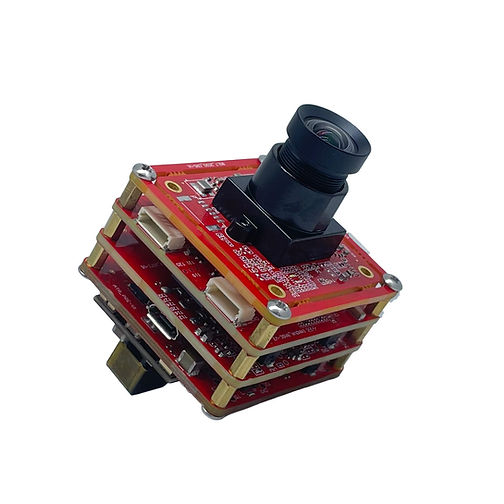
Product Overview
The Innowave-2020CRS is a 20MP color network camera built on the Onsemi AR2020 sensor with Gigabit Ethernet and WiFi in one unit. As a 20MP PTP Synchronization GigE WiFi Camera, it aligns frames across several camera units, and as a 20MP Onboard Storage GigE WiFi Camera, it keeps recording locally when a network link drops. The 20MP Unicast Multicast GigE WiFi Camera designation covers both streaming modes, and the 20MP Onboard Dewarping Engine Camera designation covers the correction of lenses up to 200 DFOV inside the camera. It is an Embedded Vision GigE WiFi Camera for engineers who want standard interfaces and finished video from one module, an Embedded Vision Engineer Camera that avoids custom drivers, and a System Integrator GigE Camera that fits both wired and wireless sites.
Key specs: 20MP (5120 x 3840) Max Resolution | Onsemi AR2020 1/1.8 inch Sensor Format | 1.4 micron Pixel | Color with Rolling Shutter | Gigabit Ethernet and WiFi Interfaces | M12 Lens Mount with Electromechanical IR Cut Filter
Key Capabilities of the 20MP Color GigE WiFi Camera
Gigabit Ethernet and WiFi Connectivity
One camera serves both wired and wireless sites. An installer can commission the unit wirelessly, then run it on a cable for the full 20MP stream, or keep it wireless where cabling is impractical. If a cable fails, the wireless link can keep the camera reachable. The AR2020 sensor behind both links is the same, so a fleet of mixed sites uses one part number, one set of spares, and one set of settings. Vadzo advises on how to divide traffic between the two interfaces for each design. Many sites send the full stream over the cable and keep the wireless link for configuration and light viewing, and some use the wireless link only as a backup path that activates when the cable is lost.
ONVIF Compliance for Network Camera Integration
ONVIF is an industry standard that lets network video products from different makers work together. Because the camera complies with ONVIF, standard video management and recording software can discover it and request its video without custom code. This shortens commissioning in large sites, where installers expect a camera to appear in their software with little effort. Teams should confirm the specific ONVIF features and profiles they need against the product documentation. An AR2020 ONVIF Gigabit Ethernet WiFi Camera also lets a site keep one discovery method across its wired and wireless units.
IEEE 1588 PTP Synchronization for Multi-Camera Systems
When several camera units cover one scene, reviewers need recordings that line up in time. The Precision Time Protocol, defined in IEEE 1588, synchronizes each camera clock to a network time source, so frames share a common time base. PTP depends on a network that supports it, and the best accuracy comes on the wired link, because wireless delay varies. A short pilot on the real switches shows the alignment a site can expect, and an AR2020 PTP Synchronization GigE WiFi Camera makes that test possible with a single model.
Onboard Storage for Network Interruptions
Networks drop packets and wireless links drop out. Onboard storage lets the camera keep recording locally while the link is down, so the footage can be copied back afterward instead of being lost. The feature suits sites with unreliable connections and mobile platforms that move in and out of coverage. Teams should confirm the storage capacity, format, and retrieval method for their design, and plan how long footage must be kept. An AR2020 Onboard Storage GigE WiFi Camera turns a network gap from lost footage into a delayed copy.
Unicast and Multicast Streaming for Multi-Client Access
Unicast sends a separate stream to each viewer, which is simple and works everywhere. Multicast sends one stream that the network copies to many viewers, which saves bandwidth when many clients watch the same camera. Multicast needs switches that support it, and over WiFi it is usually sent at a low data rate that can slow the wireless network, so Vadzo recommends using multicast on the wired link and unicast on the wireless one. An AR2020 Multicast Streaming GigE WiFi Camera should be tested with the real switches, since multicast support varies.
Onboard Dewarping Support for Lenses up to 200° DFOV
Very wide lenses capture a huge area and bend the picture strongly. The onboard dewarping engine flattens the image inside the camera for lenses up to 200 DFOV, so any client receives a usable view without spending its own processing power. The correction is set for a particular lens and gives up some field of view at the edges in exchange for straight lines. A 20MP Dewarping Engine GigE WiFi Camera of this kind keeps useful detail after correction, since the sensor supplies about 32 pixels per degree at the center in the illustrative model. Teams should confirm the usable field and the edge resolution with their own lens.
Rolling Shutter Performance in Dual Interface
The sensor reads the image row by row, which gives high resolution and good low-light sensitivity at reasonable cost. For most monitoring, inspection, and analytics scenes, the effect is invisible, and fast subjects can show slight skew, which short exposures reduce. Vadzo offers global shutter camera models in its portfolio for scenes where fast continuous motion is the main concern. Many monitoring scenes do not need that, and the rolling shutter serves them well.
M12 Lens Mount with Electromechanical IR Cut Filter
The M12 lens mount accepts a wide range of lenses, so teams can choose the field of view and aperture for the site. The electromechanical IR cut filter blocks near-infrared light by day, which keeps colors true, and moves out of the way at night, so the sensor can use infrared illumination. As a 20MP GigE WiFi Camera Manufacturer, Vadzo supports lens matching, firmware customization, and enclosure design for volume programs. Teams moving from evaluation to volume keep the same camera and documentation.
“Integrators told us they were tired of stocking two camera types for one job, one for wired sites and one for wireless. The Innowave-2020CRS combines both links in a single camera. It also brings the standards that make a large deployment manageable, which are ONVIF, PTP, and unicast and multicast streaming, along with onboard storage for the times a link drops. We are straightforward about the physics, because customers value plain answers more than broad promises. WiFi is slower and less steady than a cable, so we recommend the wired link for the full 20MP stream and multicast, and we help customers plan the rest. The onboard dewarping engine then makes very wide lenses practical for engineers who want a usable picture from the camera itself.” – Alwin Vincent, Product Manager, Vadzo Imaging.
Dual-Interface Imaging Across Seven Application Areas
Smart City Monitoring and Parking Management
City systems mix cabled poles and quick wireless deployments. The Innowave-2020CRS works as a Parking Lot Management GigE WiFi Camera that covers a wide lot with a dewarped fisheye view, and as a Sports Analytics GigE WiFi Camera, it can serve venues and public spaces where a cable is not practical.
Telematics and Fleet Monitoring with Dual Connectivity
Vehicles and depots combine moving platforms with fixed docks. As a Wireless Embedded Vision Camera, the module can report over WiFi at the depot and over a cable on the dock, and onboard storage keeps footage when a vehicle leaves coverage. Fleet teams can then collect the clips when the vehicle returns to the depot.
Kiosk Imaging and Document Capture
Kiosks need a camera that installers can commission quickly. The module serves as a Biometric Authentication GigE WiFi Camera and a Document Scanning GigE WiFi Camera where 20MP detail captures faces and documents. Biometric products carry privacy and legal duties that belong to the device maker. Installers also value that the same unit can be commissioned over WiFi before the cable is run, which lets them aim and focus the camera while a ladder is still in place.
Medical Imaging and Patient Care Systems
Medical instruments and care settings value clean, detailed color. The camera functions as a Digital Pathology GigE WiFi Camera for specimen and slide imaging with suitable optics. Device makers remain responsible for performance claims and the regulatory pathway of the finished device. A wired link suits fixed instruments, while WiFi suits mobile carts.
Security Surveillance with Wide-Area Coverage
Surveillance wants wide coverage, day and night operation, and dependable recording. The module works as a Smart Surveillance GigE WiFi Camera with the IR cut filter and dewarped wide views, and as a Forensic Analysis GigE WiFi Camera whose 20MP frames leave room to zoom into detail after an event. Onboard storage protects the record when a network link drops.
Industrial Automation and Robotics Imaging
Factories and robots need flexible networks and clear images. The camera serves as a Robotics GigE WiFi Camera on mobile platforms that move between wired and wireless zones, and as an Industrial Quality Inspection GigE WiFi Camera where 20MP detail reveals small defects. Fast-moving lines may call for a global shutter camera. Mobile robots benefit from commissioning over WiFi and running on a cable at the dock.
Retail Automation and Shelf Monitoring
Stores change layouts often, and wireless units are quick to place. As an Embedded Vision Ethernet WiFi Camera, the module covers shelves and aisles with a dewarped wide view, and the wired link serves fixed positions that need the full stream. Retail teams can start with WiFi and move to cable once the layout settles.
Frequently Asked Questions
Q: Why put Gigabit Ethernet and WiFi in the same camera?
A: Vadzo Imaging explains that real sites differ. Fixed positions suit a cable, while temporary or moving positions suit a wireless link, and a camera with both lets one model serve either. It also gives a fallback, since the wireless link can keep the camera reachable if the cable fails. A 20MP Ethernet WiFi Camera simplifies spares and training, and a 20MP ONVIF GigE WiFi Camera keeps the software side standard, and Vadzo Imaging recommends using the cable for the full stream where the site allows, and an Ethernet WiFi camera of this kind lets teams make that choice site by site.
Q: Does multicast streaming work well over WiFi?
A: Multicast sends one stream that the network copies to many viewers, which saves bandwidth on a wired network. Over WiFi, multicast is usually sent at a low data rate, which can slow the whole wireless network, so it is best used on the wired side. A 20MP Unicast Multicast GigE WiFi Camera lets teams choose the mode that suits each link. Vadzo Imaging suggests testing both on the real network, since switches and access points differ in how they handle multicast.
Q: What does an onboard dewarping engine do for a wide-angle lens?
A: Wide lenses, up to 200 degrees diagonal, capture a very large area and bend the picture strongly. A dewarping engine flattens the image inside the camera, so any viewer receives a usable picture without spending processing power, and a 20MP Onboard Dewarping Engine Camera does this for lenses up to 200 degrees. It trades a little field of view at the edges for straight lines, and it is set for a particular lens. Vadzo Imaging helps teams choose the lens and the dewarping profile together.
Q: Is PTP synchronization accurate over WiFi?
A: PTP gives its best accuracy on a wired network that supports the protocol, because wireless links add variable delay. A 20MP PTP Synchronization GigE WiFi Camera can still align its clock over a wireless link, with lower precision. Vadzo Imaging recommends using the wired link for time-critical multi-camera work and testing the alignment on the real switches before a large rollout.
Q: Why should integrators choose Vadzo Imaging as their 20MP GigE WiFi Camera Manufacturer?
A: Vadzo Imaging offers more than a camera module built around a capable sensor. Integrators working with Vadzo Imaging receive a camera that combines wired and wireless links with ONVIF, PTP, onboard storage, and onboard dewarping, along with candid guidance on what WiFi can and cannot carry, plus engineering support for lens selection, firmware customization, and enclosure design. Vadzo Imaging maintains evaluation kits with no minimum order requirement, so teams can test on their own network before committing to volume production.
Availability
The Innowave-2020CRS 20MP Color GigE WiFi Camera built on the Onsemi AR2020 sensor is available now for evaluation and production orders. Evaluation kits include the camera, an M12 lens, and platform documentation, with no minimum order requirement. Teams can test both links on their own network, check dewarping with their own wide-angle lens, and confirm ONVIF discovery and PTP alignment before committing to a production bill of materials, which tells them more than a datasheet comparison alone. Teams that need a different lens or dewarping profile can ask Vadzo to review the configuration. Evaluation also lets teams check how the camera behaves when a link drops, how long onboard recordings take to copy back, and how the stream looks over each interface under their own traffic. Browse the full range of network camera options at Vadzo’s website or contact Vadzo at support@vadzoimaging.com to request an evaluation unit or discuss OEM integration requirements.
About Vadzo Imaging
Vadzo Imaging is a global provider of embedded vision solutions and delivers high-performance camera technologies and imaging platforms for applications in robotics, industrial automation, UAVs, edge AI, and medical systems. Its products are designed for seamless integration with leading embedded platforms. Vadzo supports customers through hardware customization, firmware development, and module-level drivers, enabling faster development and deployment of vision-based systems across GigE, USB, MIPI, Wi-Fi, and SerDes camera interfaces.
Media Contact
Alwin Vincent
Vadzo Imaging
Email: alwin@vadzoimaging.com
LinkedIn: Vadzo Imaging
YouTube: Vadzo Imaging
X: Vadzo Imaging
SOURCE: Vadzo Imaging
View the original press release on ACCESS Newswire
Media gallery